- Simple Science
- Posts
- How I Address Gastrointestinal Symptoms
How I Address Gastrointestinal Symptoms
The gut microbiome in symptomatic patients is unbalanced, but the imbalance isn't the "root cause"—it's the result of disrupted conditions that would normally support healthy bacterial populations.

Myrto Ashe
January 14, 2026


Last chance for early-bird prices: contact me by January 15th, 2026

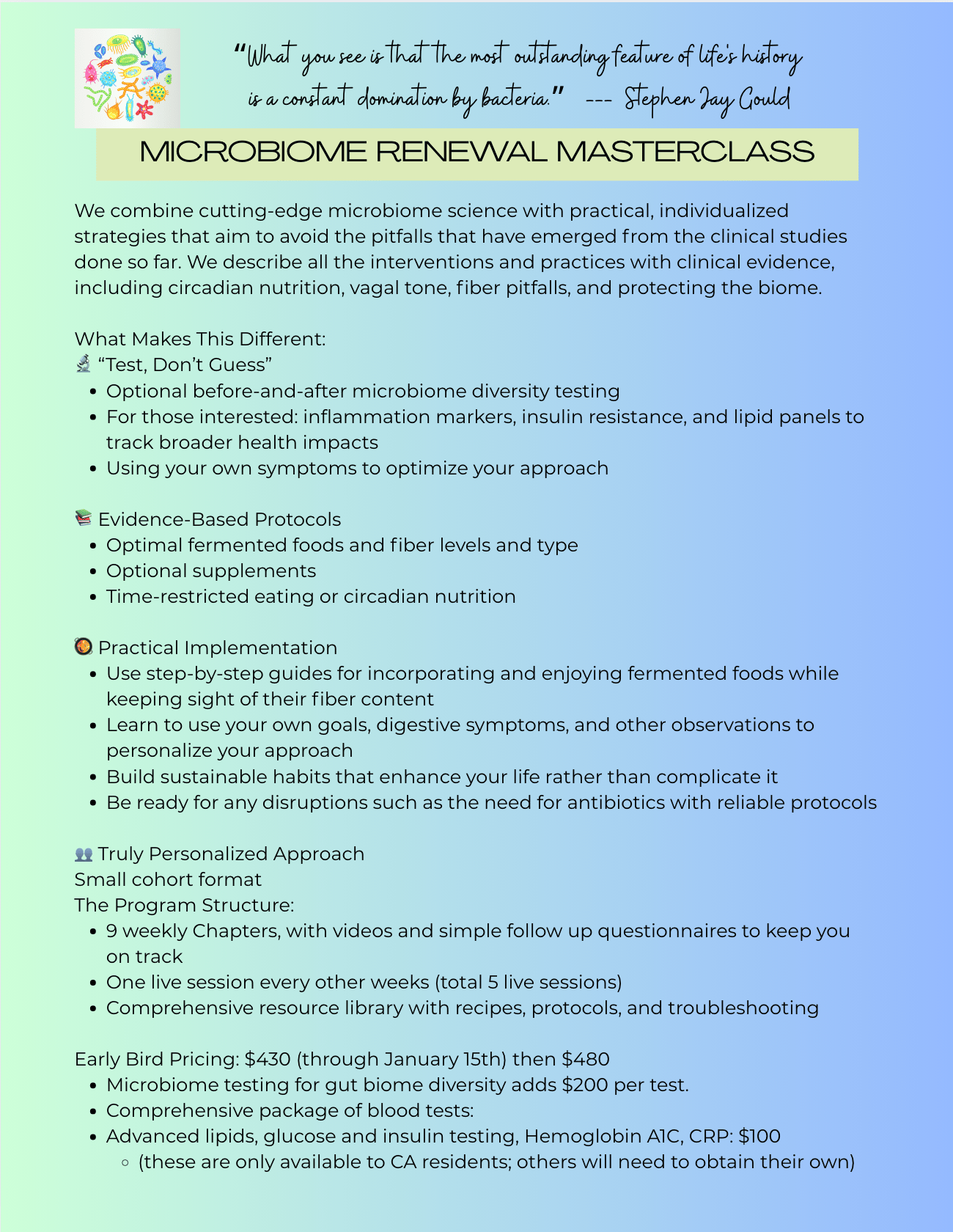
The second cohort of my nine-part Microbiome Renewal Masterclass, covering the multiple conditions that support a healthy microbiome, launches at the end of January. Versions available for health-conscious individuals and for clinicians guiding patients through gut microbiome renewal. More details at end of newsletter.
The Healing Depression Project still has some open spots for interested individuals.

How I Address
Gastrointestinal Symptoms
Quick Takes
1. The SIBO Testing Trap
Breath tests for SIBO have become ubiquitous, but they're not as reliable as marketed. The tests measure hydrogen and methane in your breath after you swallow fermentable carbohydrates, assuming they'll travel predictably through your gut. But a positive test doesn't help you discover root causes, and a negative test doesn't guarantee a healthy microbiome.
2. Rifaximin has problems
The go-to antibiotic for SIBO has a 40-45% relapse rate within nine months. It was initially described as wiping out all gut bacteria, allowing a “reset.” More recently, it is marketed as “rearranging” bacteria in helpful ways. In clinical practice, the pattern is clear: quick symptom relief too often followed by either recurrence or sometimes new problems.
3. The Methane Paradox
We're told excess methane production is pathological and requires treatment. Yet Methanobrevibacter smithii, the major methane producer in our gut, is abundant in centenarians and other long-lived populations (Roszkowska, et al, 2024). This contradiction suggests we could be missing something important about the role of methane-producing organisms in gut health.
4. Symptoms Are Meaningful
If you have gas, bloating, distention worsening through the day, and changes in bowel habits, this strongly suggests imbalance in gut microbial abundance or function. The breath test adds little actionable information if your goal is restoring the conditions that support a healthy microbiome rather than just killing some bacteria and hoping the rest of them know what to do.
Deep Dive: Why SIBO Treatment Fails (And What Actually Works)
The diagnosis of SIBO—small intestinal bacterial overgrowth—strikes fear in the hearts of many clinicians. Add IMO (intestinal methanogen overgrowth) to the mix, and you have an acronym-laden approach to a situation that still needs explanation.
The Origin Story
First described in the early 2000s and popularized by Pimentel and colleagues, SIBO was initially identified in patients with surgical bowel alterations. These patients had closed loops where bacteria could incubate and cause problems. The diagnosis required sampling the small intestine during endoscopy—an invasive, expensive procedure (Sorathia et al, 2025).
The medical reflex when faced with "overgrowth" is predictable: kill it. Early treatments combined older antibiotics like amoxicillin and metronidazole; eventually, a new option emerged: rifaximin (Soldi et al, 2015). Then came the innovation that would change everything: breath testing as a non-invasive way to approximate an endoscopic diagnosis.
By the mid-2010s, home breath test companies had emerged, and the stage was set for an explosion of SIBO/IMO diagnoses. Pair an at-home test with a rifaximin prescription, and you had what looked like a perfect solution.
It is also a repeating cycle from which many cannot escape.
Why It’s Not Enough
The problems with this approach are multiple and fundamental:
The treatment doesn't last. Rifaximin and other antibiotic approaches show an unacceptably high recurrence rate— 44% of patients relapse within nine months (Koo et al, 2012; Rao et al, 2019). Rifaximin tends to modestly reduce some potentially pathogenic taxa and increase Lactobacillus and Bifidobacterium, but these shifts are not consistent across individuals and do not reliably translate into durable symptom resolution (Zeber-Lubecka, et al, 2016).
The tests are unreliable. The fundamental assumption behind breath testing—that swallowed carbohydrates travel predictably down the small intestine at a consistent rate—doesn't hold up (Kashyap et al, 2024). Sometimes the substrate races to the colon where fermentation is desirable, creating false positives. The controversy over glucose versus lactulose testing reflects deeper uncertainty: glucose produces fewer false positives but may miss cases, while lactulose catches more cases but generates more false positives (Lim and Rezaie, 2023)
Conventional medicine has accepted that SIBO is a recurrent illness that you have to keep testing and treating, over and over (Silva et al, 2025).
The Real Problem
The gut microbiome in symptomatic patients is unbalanced, but the imbalance isn't the root cause—it's the result of disrupted conditions that normally support healthy bacterial populations. Conceptually, the microbiome imbalance is the downstream result of (Roszkowska et al, 2024):
Antibiotic prescriptions
Periods of high stress
Unsuitable food (includes processed, too much sugar, food intolerances, etc.)
Gastrointestinal infections
Mitochondrial dysfunction
Metabolic and nutrient problems
Proton pump inhibitor (PPI) use (Hu et al, 2025)
It may take several disruptions occurring together to push the microbiome into a pathological pattern. Once perturbed, the system may not reliably return to balance on its own. Multiple conditions must be corrected to promote and stabilize a healthy gut ecosystem. Otherwise, the system tends to drift back to the abnormal state rather than snapping into a healthy configuration.
A Different Approach
If we want a science-based, root-cause oriented and durable way to resolve bloating, gas, loose stools, and constipation, the goal shouldn't be to suppress symptoms or kill bacteria. The aim should be to address the root causes of microbiome dysregulation and restore the conditions that support a stable, healthy bacterial ecosystem.
My health conscious savvy readers know that an optimal bacterial ecosystem is what we all need for healthy metabolism, cognition, mood, energy, bones, etc.
This means stopping the reflex to test and treat with “kill” approaches. Instead:
Start with symptoms, not tests. If you have gas, bloating, diarrhea, constipation, or abdominal distention that worsens after meals or later in the day, your gut microbiome is almost certainly not in optimal health. The breath test adds limited actionable information if your strategy is to correct underlying conditions rather than just differentiating between hydrogen and methane producers.
Address underlying conditions systematically. This requires identifying and correcting the multiple factors that prevent a healthy microbiome from establishing itself. Low FODMAP diets and herbal remedies (some studies show certain herbal combinations equivalent to rifaximin) can play a role, but only in the context of addressing root causes.
Aim for stable restoration, not symptom suppression. The treatment goal should be creating conditions that allow a healthy microbiome to establish and maintain itself, preventing drift back to an abnormal configuration.
This approach requires patience and systematic work, but it offers something antibiotics and breath tests cannot: the possibility of lasting resolution rather than temporary suppression followed by inevitable relapse.
Let me know what you think, what you would like to read about, and leave a comment when you respond to the poll below! |  | Simple Science was created so I could share the multiple tips and insights I have discovered from 38 years of medical practice, and that I continue to gain through reading the science literature and collaborating with colleagues. |
What did you think of this newsletter? |
 | NEW BOOK A collection of 60 unusually effective health-related practices, The Simple Science of Wellness, available at Barnes and Noble (ebook and print book): Insights from 38 years of clinical practice, paired with | research results from the latest science. Soon available also at environmentally responsible print-on-demand retailer Lulu.com. 📖 🧑⚕️ 🍃 🧠 |
REFERENCES
Hu L, Lai C, Li Y, Sun R, Yang H, Liu X, Peng Y. The association of proton pump inhibitors and inflammatory bowel disease from the perspective of gut microbiota perturbation. NPJ Biofilms Microbiomes. 2025
Kashyap P, Moayyedi P, Quigley EMM, Simren M, Vanner S. Critical appraisal of the SIBO hypothesis and breath testing: A clinical practice update endorsed by the European society of neurogastroenterology and motility (ESNM) and the American neurogastroenterology and motility society (ANMS). Neurogastroenterol Motil. 2024
Koo HL, Sabounchi S, Huang DB, DuPont HL. Rifaximin therapy of irritable bowel syndrome. Clin Med Insights Gastroenterol. 2012
Lim J, Rezaie A. Pros and Cons of Breath Testing for Small Intestinal Bacterial Overgrowth and Intestinal Methanogen Overgrowth. Gastroenterol Hepatol (N Y). 2023
Rao SSC, Bhagatwala J. Small Intestinal Bacterial Overgrowth: Clinical Features and Therapeutic Management. Clin Transl Gastroenterol. 2019
Roszkowska P, Klimczak E, Ostrycharz E, Rączka A, Wojciechowska-Koszko I, Dybus A, Cheng YH, Yu YH, Mazgaj S, Hukowska-Szematowicz B. Small Intestinal Bacterial Overgrowth (SIBO) and Twelve Groups of Related Diseases-Current State of Knowledge. Biomedicines. 2024
Silva BCD, Ramos GP, Barros LL, Ramos AFP, Domingues G, Chinzon D, Passos MDCF. DIAGNOSIS AND TREATMENT OF SMALL INTESTINAL BACTERIAL OVERGROWTH: AN OFFICIAL POSITION PAPER FROM THE BRAZILIAN FEDERATION OF GASTROENTEROLOGY. Arq Gastroenterol. 2025
Soldi S, Vasileiadis S, Uggeri F, Campanale M, Morelli L, Fogli MV, Calanni F, Grimaldi M, Gasbarrini A. Modulation of the gut microbiota composition by rifaximin in non-constipated irritable bowel syndrome patients: a molecular approach. Clin Exp Gastroenterol. 2015
Sorathia SJ, Chippa V, Rivas JM. Small Intestinal Bacterial Overgrowth. [Updated 2023 Apr 17]. In: StatPearls [Internet]. Treasure Island (FL): StatPearls Publishing; 2025
Zeber-Lubecka N, Kulecka M, Ambrozkiewicz F, Paziewska A, Goryca K, Karczmarski J, Rubel T, Wojtowicz W, Mlynarz P, Marczak L, Tomecki R, Mikula M, Ostrowski J. Limited prolonged effects of rifaximin treatment on irritable bowel syndrome-related differences in the fecal microbiome and metabolome. Gut Microbes. 2016